Why Should Everyone Do Pilates? 9 Main Benefits
Pilates is often seen as a “core workout,” but in reality, it’s much more than that. It’s a method that connects strength, posture, breathing, and body awareness into one practice.
The goal isn’t perfection.
The goal is confidence, feeling good in your body.
That was also the original intention of Pilates creator Joseph Pilates: to help people move better, live healthier, and feel more in control of their bodies.
Why Pilates Works?
Pilates was developed by Joseph Pilates, born in Germany in 1883.
During World War I, he trained fellow prisoners in internment camps. Because there was no equipment available, he used bodyweight and gravity to create exercises, which later became the foundation of mat Pilates.
In 1926, he opened the first Pilates studio in New York.
Originally, the method was called Contrology, because the focus was on controlling the body with the mind. After his death, the method became known simply as Pilates.
Today, Pilates continues to evolve, which is why it remains modern and relevant even nearly 100 years later.
1. Pilates Builds Deep Core Strength
When people think about core training, they often imagine visible abdominal muscles. But Pilates focuses on something much more important: the deep stabilizing muscles that support your spine and pelvis from the inside.
These muscles include the transverse abdominis, pelvic floor, deep back muscles, and diaphragm. Together, they create what Pilates calls the powerhouse — the center of strength and stability in your body.
Instead of doing fast, repetitive movements, Pilates trains these muscles through slow, controlled exercises that teach them to activate correctly. This creates strength that is functional, balanced, and supportive, not just aesthetic.
A strong deep core helps you:
Protect your lower back
Improve posture and alignment
Move with more control and efficiency
Reduce strain during daily activities
Feel more stable and confident in your body
Many people notice that everyday movements like lifting, walking, or sitting for long periods start to feel easier once their deep core becomes stronger.
This is why Pilates strength feels different from traditional workouts. It’s not about pushing harder.
It’s about building support from the inside out.
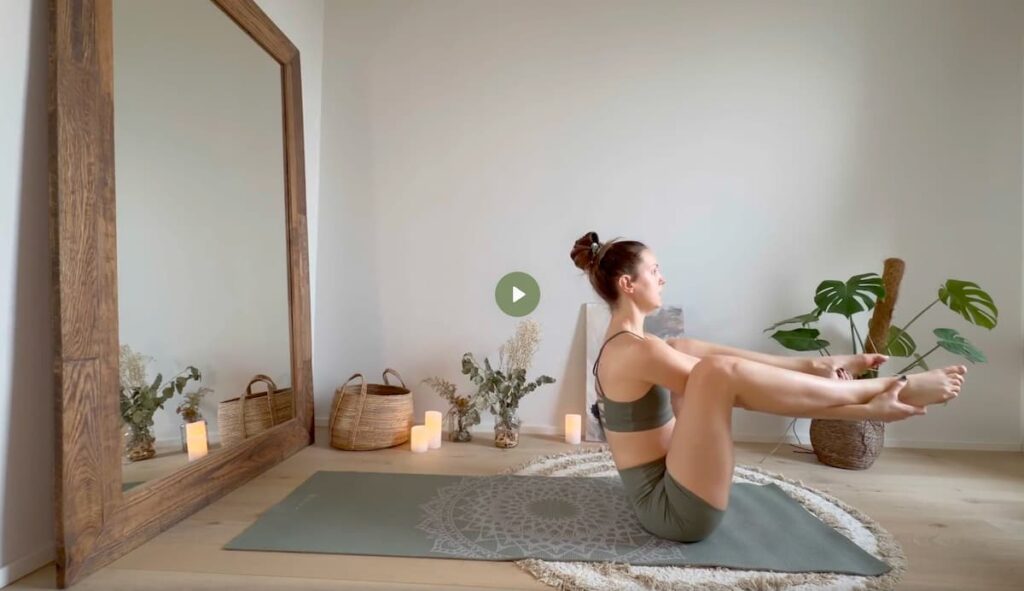
Here’s a Pilates class you can try at home to activate your deep core muscles and experience how Pilates strength feels from the inside.
2. Pilates Improves Posture and Spine Health
Pilates places strong focus on the spine.
Your posture affects how gravity impacts your body.
The more aligned your posture is, the less pressure gravity puts on your spine.
Many people experience back pain not because of injury, but because of poor posture and weak stabilizing muscles.
Pilates helps by:
Strengthening muscles that support alignment
Improving spinal mobility
Teaching you how to hold your body efficiently
A healthy spine is the foundation of movement, which is the foundation of life.
3. Pilates Improves Flexibility and Mobility
Many people think flexibility is something you either have or don’t, but in reality, it’s strongly influenced by how you move every day.
If you spend hours sitting at a desk, your body adapts to that position. Hip flexors shorten, the chest tightens, the upper back stiffens, and the spine loses its natural mobility. Over time, this can lead to discomfort, poor posture, and a higher risk of tension or pain.
Pilates gently restores movement where your body needs it most.
Through controlled stretching combined with strength, Pilates improves flexibility while also teaching muscles to support your joints. This means you’re not just becoming more flexible but more stable within that flexibility, which is key for long-term comfort and injury prevention.
For office workers especially, regular Pilates can help:
Open tight hips from prolonged sitting
Release tension in the neck and shoulders
Improve spinal mobility and posture
Reduce lower back discomfort
Counteract the effects of sedentary habits
The result is a body that feels lighter, freer, and more comfortable, both during workouts and in everyday life.
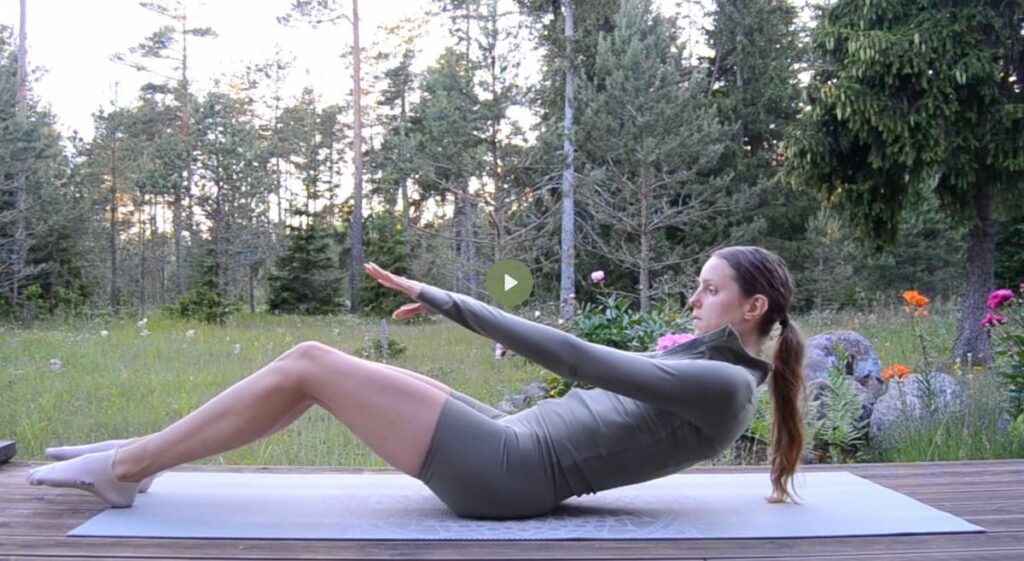
If you spend a lot of time sitting or feel stiffness in your hips, back, or shoulders, this gentle 28-minute Pilates session can help restore movement and reduce tension.
4. Pilates Reduces Stress and Supports Mental Well-Being
Pilates is not only physical exercise; it directly affects your nervous system.
Slow, controlled movements combined with conscious breathing help shift your body out of “fight or flight” mode into a calmer state. Many people notice they feel more relaxed, focused, and emotionally balanced after a session.
Regular Pilates can:
Lower stress levels
Improve mood and energy
Reduce tension stored in the body
Support better sleep
Create a sense of calm after busy days
It becomes a space where you pause, breathe, and reconnect with yourself.
5. Pilates Improves Body Awareness and Mind-Body Connection
One of the most unique things about Pilates is how it teaches you to feel your body from the inside, not just move it.
Instead of rushing through exercises, you learn to notice posture, muscle activation, alignment, and movement patterns. Over time, this awareness carries into everyday life — how you sit, stand, walk, and even how you respond to physical stress.
Better body awareness helps you:
Move more efficiently and safely
Activate the right muscles at the right time
Improve coordination and balance
Prevent injuries
Feel more confident in your body
Pilates isn’t just training muscles; it’s training your brain and body to work together.
This 25-minute calming session focuses on breathing, slow movement, and nervous system relaxation. Perfect after a long day or when you need to reconnect with your body.

6. Pilates Helps Prevent Injuries
One of the biggest benefits of Pilates is injury prevention.
Many injuries don’t happen because the body is weak. They happen because muscles are imbalanced, stiff, or not working together properly. Pilates focuses on deep stabilizing muscles, joint alignment, and controlled movement, which creates a more resilient body.
By improving strength, mobility, and coordination at the same time, Pilates helps your body respond better to sudden movements, physical stress, and everyday demands.
Regular practice can:
Reduce risk of back pain and joint problems
Improve muscle elasticity and flexibility
Strengthen stabilizing muscles around joints
Support recovery after injuries
Protect the spine during daily activities and sports
This is also why many physiotherapists and professional athletes use Pilates as part of training and rehabilitation.
In fact, I personally believe every athlete could benefit from Pilates. For example, many football players are extremely strong but not very flexible, and improving muscle elasticity and control could significantly reduce injury risk.
Pilates creates a body that is not only strong, but adaptable and durable.
7. Pilates Improves Movement Quality
In Pilates, quality matters more than quantity.
Five precise repetitions can be more effective than twenty rushed ones.
The goal is efficient movement, sometimes described as effortless effort, where movements feel light and natural even though muscles are working.
Over time, this creates graceful, confident movement similar to dancers.
8. Pilates Is Adaptable for Everyone
Pilates can be done:
On a mat
With small props
On specialized equipment like the reformer
At home or in a studio
For beginners or advanced movers
Interestingly, mat Pilates is often the most challenging, because there’s less support from equipment, meaning your muscles do more work.
9. Pilates Supports Long-Term Health and Aging
One of the most powerful reasons people practice Pilates is longevity.
Strong stabilizing muscles, good posture, and spinal mobility help you:
Move better as you age
Reduce pain
Maintain independence
Stay active longer
The goal isn’t just fitness today, it’s a healthy body for life.
The Core Principles Behind Pilates
Pilates is based on key principles, including:
Concentration
Control
Centering (core activation)
Precision
Breathing
Flow
Posture
Integration of body and mind
You don’t learn all of them at once. They develop gradually through practice.
Over time, these principles extend beyond exercise into daily life.
Pilates Benefits for Women and Men
I truly believe Pilates is beneficial for almost everyone, including professional athletes.
Many sports focus heavily on strength and power but don’t always prioritize mobility, deep stability, and muscle elasticity. This imbalance is often where injuries happen.
Pilates helps create a body that is not only strong, but also balanced, controlled, and resilient.
More elastic muscles and better joint stability mean the body can respond faster and safer to sudden movements, which reduces injury risk.
Pilates Benefits for Women
Pilates is especially supportive for women because it strengthens the muscles that stabilize the spine and pelvis — areas that go through many changes during life.
It can help with:
Core and pelvic floor strength
Better posture and body confidence
Reduced back and neck pain
Hormonal balance through nervous system regulation
Strength without excessive joint stress
Improved mobility and circulation
Pilates is also highly beneficial before and after pregnancy.
Before pregnancy, it helps build deep core and pelvic stability, which can support the body during pregnancy and reduce discomfort.
After pregnancy, gentle Pilates can help reconnect with the core and pelvic floor muscles, improve posture, and restore strength safely, especially when guided by a qualified instructor.
Many women also appreciate that Pilates creates a strong, toned body without pressure or extremes. It focuses on feeling good and supported in your body, not forcing it.
Pilates Benefits for Men
Pilates is sometimes misunderstood as being “easy” or only for women, but in reality it can be extremely challenging, and very effective for men.
Men often have more muscle mass but less flexibility and mobility, especially in the hips, hamstrings, and spine. This stiffness can increase strain on joints and lead to injuries over time.
Pilates improves:
Flexibility and muscle elasticity
Core strength and spinal support
Joint stability and control
Posture and movement efficiency
Injury prevention
For example, many football players are very strong but also quite tight. If muscles are not elastic enough, sudden movements like sprinting, turning, or stopping can overload the body.
Pilates trains the smaller stabilizing muscles that support the bigger ones, helping the body move more efficiently and safely.
That’s why many elite athletes use Pilates as part of their training, not instead of their sport, but to perform better in it.
Why Is Pilates Good for Dancers?
Pilates and dance work beautifully together.
Both require control, alignment, balance, and body awareness. Pilates strengthens the stabilizing muscles that dancers rely on for technique and injury prevention.
It helps dancers:
Improve posture and alignment
Increase core stability
Gain better balance and control
Move more efficiently
Reduce injury risk
Develop fluid, coordinated movement
I personally dance about four times a week, and Pilates has made a huge difference in how stable and strong I feel during movement. It helps me connect to my body more deeply and move with more control instead of tension.
Many professional dancers use Pilates as part of their regular training for exactly this reason.
Why I Love Pilates — And Why You Might Too
For me, Pilates is not just exercise.
It’s time to reconnect with my body.
To move, breathe, and slow down.
It makes me feel strong, but also calm. Energized, but also grounded.
I love that Pilates isn’t about pushing harder or doing more. It’s about moving better. Listening. Understanding how your body works.
And the best part is, the benefits don’t stay on the mat. You notice them when you sit, walk, dance, carry groceries, or simply exist in your body. You feel more supported from the inside.
If you want to feel stronger, more confident, and more connected to yourself, Pilates is one of the most powerful things you can do.